Stump Neuroma Audio Overview
Listen to a clear, easy-to-understand overview of stump neuroma, including causes, symptoms, and how it can be treated.


Listen to a clear, easy-to-understand overview of stump neuroma, including causes, symptoms, and how it can be treated.
Most patients undergo surgery for Morton’s neuroma in the hope of relieving chronic forefoot pain. While many patients do experience improvement following surgery, some individuals continue to experience persistent symptoms or develop new pain in the forefoot.
One possible explanation for this is the formation of a stump neuroma, which occurs when the remaining portion of the nerve attempts to regenerate after the original neuroma has been surgically removed.
In some cases the regenerating nerve may form a sensitive nerve ending that becomes irritated during walking or weight-bearing activities. This can lead to symptoms similar to the original neuroma, including burning pain, sharp sensations in the toes, or discomfort when wearing shoes.
At The Barn Clinic we specialise in the assessment and treatment of forefoot nerve conditions and offer ultrasound-guided cryosurgery, a minimally invasive procedure designed to reduce nerve pain while preserving surrounding tissue structures.




Although surgical excision is widely performed, published outcome studies suggest that results can be variable.
Some studies have reported that up to 40% of patients may experience persistent or unsatisfactory outcomes following Morton’s neuroma surgery.
These outcomes may include:
Importantly, the exact frequency of stump neuroma formation is difficult to determine. In many studies, patients with ongoing pain are simply recorded as having persistent symptoms rather than receiving a specific diagnosis of stump neuroma.
For this reason, the true incidence of stump neuroma formation may be higher than reported in the literature.
Approximately 40% of patients reported unsatisfactory outcomes following Morton’s neuroma excision
Long-term follow-up demonstrated persistent or recurrent symptoms in a proportion of patients
Complications reported include persistent pain, scar sensitivity and stump neuroma formation
When a nerve is surgically divided, the remaining nerve attempts to regenerate. During this process the end of the nerve may enlarge and form a bulb-like swelling known as a terminal neuroma or union bulb.
In addition to enlarging, the orientation of the nerve may also change.
Under normal anatomical conditions the interdigital nerve runs horizontally between the metatarsal heads, where it is relatively protected from direct pressure during walking.
Following surgical excision, however, the regenerating nerve end may adopt a more vertical orientation, pointing toward the plantar surface of the foot.
When this occurs the enlarged nerve ending may become exposed to direct loading during walking, meaning body weight can be applied directly to the sensitive nerve tissue.
This structural change may explain why stump neuromas can sometimes be perceived as more painful than the original Morton’s neuroma.
Common symptoms include:
Accurate diagnosis is important in patients experiencing persistent forefoot pain after surgery.
Diagnosis usually involves:
Evaluation of symptoms and surgical history.
High-resolution ultrasound can often identify nerve remnants or stump neuromas within the intermetatarsal space and can also help guide treatment.
At The Barn Clinic we offer ultrasound-guided cryosurgery, a minimally invasive treatment designed to reduce nerve pain.
Our clinic has extensive experience performing ultrasound-guided cryosurgery for forefoot nerve conditions, including both primary Morton’s neuromas and persistent nerve pain following previous surgery.
Cryosurgery works by applying controlled freezing to the affected nerve using a specialised probe. The freezing process interrupts abnormal pain signals while preserving surrounding tissue structures.
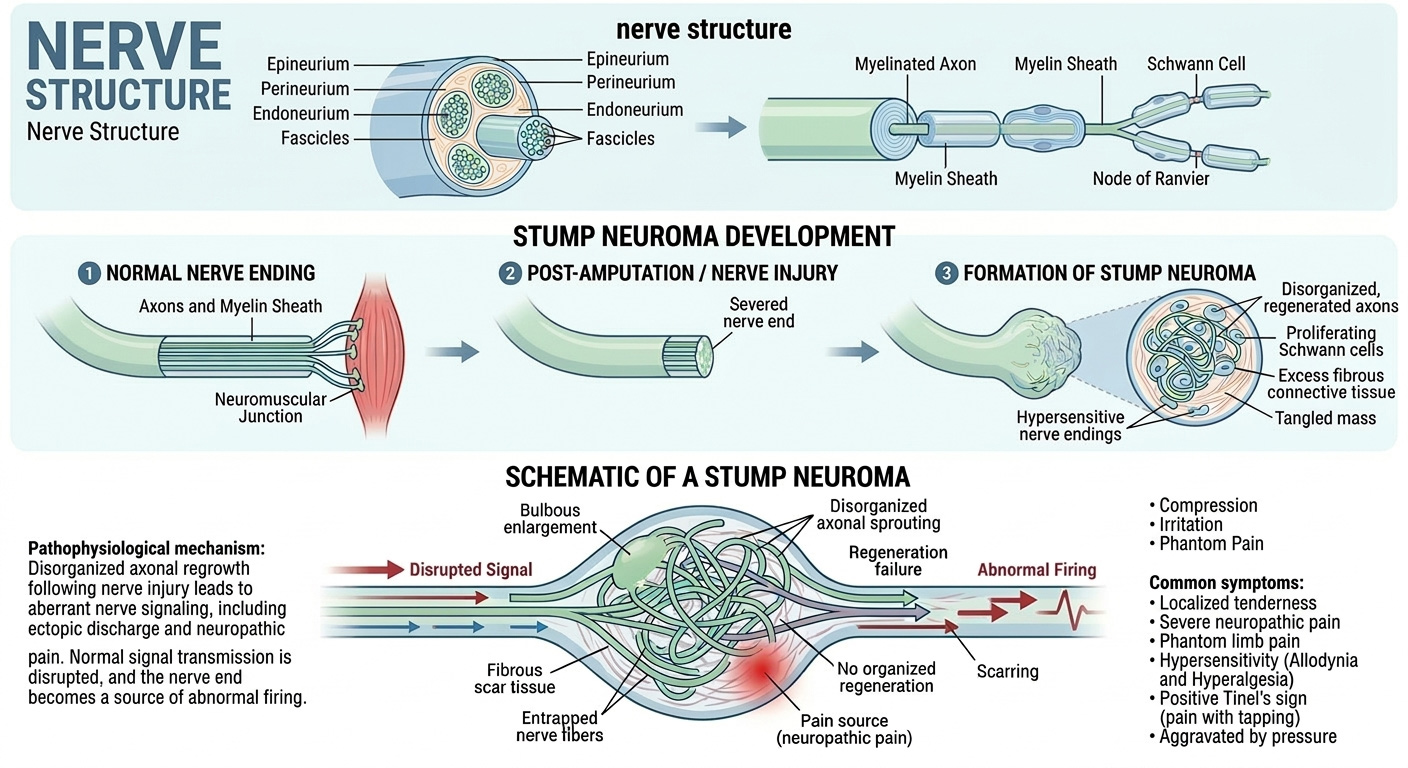
Click image to enlarge for a clearer view.
When a nerve is exposed to freezing temperatures several biological changes occur.
Temporary interruption of nerve conduction disrupts pain signals.
The portion of the nerve beyond the treatment site undergoes a natural biological process known as Wallerian degeneration, in which damaged nerve fibres break down.
Importantly the connective tissue layers surrounding the nerve remain intact and act as a framework that allows the nerve to regenerate.
Over time the nerve may regenerate along these preserved pathways, often transmitting normal sensation rather than chronic pain signals.
Alcohol injections have been used by some practitioners in the treatment of Morton’s neuroma.
However, in our clinical experience patients who have previously undergone alcohol injection therapy may demonstrate increased scarring and tethering of the nerve within surrounding tissues. This can make subsequent treatment more complex and for this reason alcohol injections are not typically recommended in our treatment approach.
Many patients treated with cryosurgery experience significant improvement in symptoms, and some patients can achieve complete relief of pain.
Studies examining cryoablation for painful amputation stump neuromas lesions that are similar in size and structure to stump neuromas following Morton’s neuroma surgery—have demonstrated substantial reductions in pain scores and improved functional outcomes following treatment.
For example:
Prologo JD et al. Percutaneous Image-Guided Cryoablation for Painful Stump Neuromas in Amputees. Journal of Vascular and Interventional Radiology.
These findings are in keeping with our clinical experience, where many patients treated with ultrasound-guided cryosurgery achieve meaningful improvements in pain and walking comfort.
Patients who have previously undergone Morton’s neuroma surgery may wish to seek specialist assessment if they experience:
Patients experiencing persistent pain following Morton’s neuroma surgery may benefit from assessment by clinicians experienced in forefoot nerve conditions.
At The Barn Clinic we perform detailed clinical evaluation and ultrasound imaging to determine the cause of ongoing symptoms and discuss potential treatment options including ultrasound-guided cryosurgery.
Yes. While many patients improve following surgery, some continue to experience pain. One possible cause is stump neuroma formation.
A stump neuroma is a painful enlargement that forms at the cut end of a nerve following surgery when the nerve attempts to regenerate.
Yes. Symptoms may develop months or even years after the original procedure.
High-resolution ultrasound imaging can often identify nerve remnants or stump neuroma formation.
Cryosurgery may help relieve nerve pain by interrupting abnormal nerve signalling using controlled freezing applied under ultrasound guidance.
Read our real patient case study describing the treatment of a painful stump neuroma using ultrasound guided cryosurgery and the outcome following treatment.