Intermetatarsal bursitis · part 1
Intermetatarsal Bursitis and Morton's Neuroma: Telling Them Apart
What the intermetatarsal bursa does, how chronic bursitis can lead to a Morton's neuroma, and why the two are so often confused.
- What the intermetatarsal bursa does. Bursas are small sacs of synovial fluid sitting around joints and between the structures of the forefoot that act as lubricating mechanical buffers.
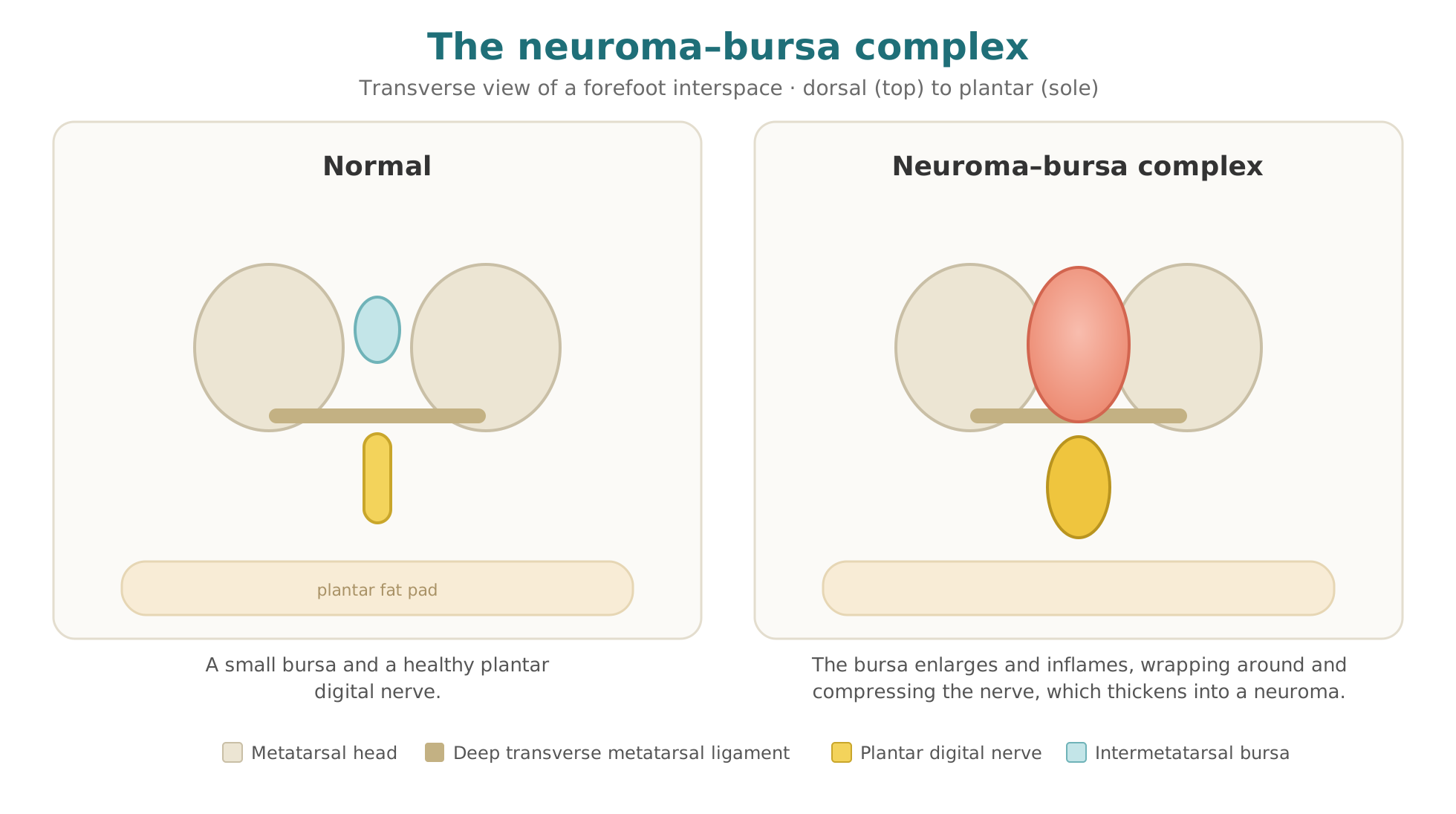
- Bursitis as a precursor to Morton's neuroma. When a forefoot bursa becomes chronically inflamed, fibrotic and enlarged, it presses on the adjacent plantar nerve — causing nerve compression, thickening and fibrosis that leads to a Morton's neuroma.
- High rate of co-existence and misdiagnosis. Around 40% to 50% of patients presenting with Morton's neuroma have co-existing bursopathy. Imaging studies show that only around 20% of patients who think they have a neuroma actually have one on scan — the remaining 80% have other causes, most frequently intermetatarsal bursitis.
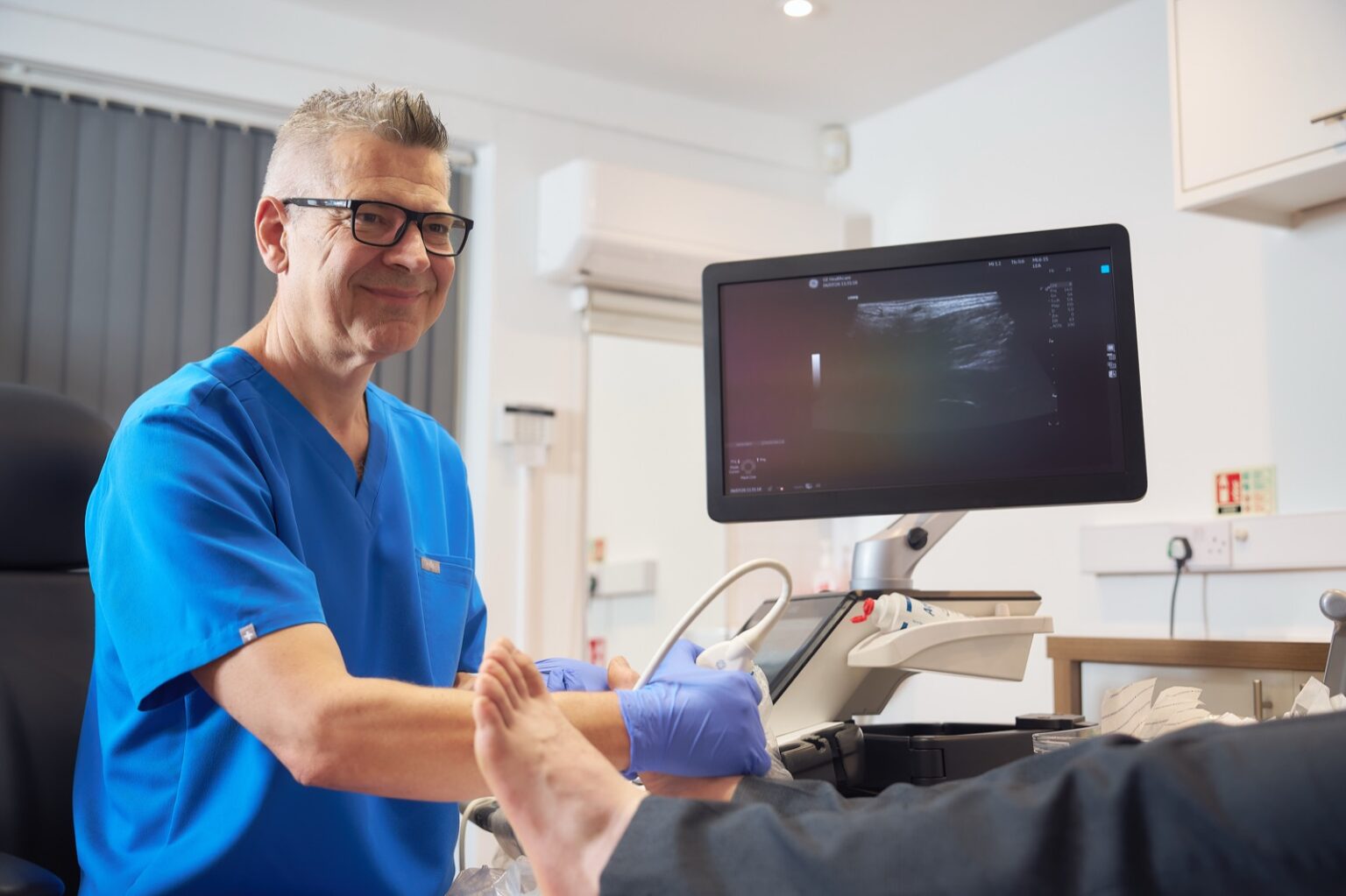
- Why clinical separation is difficult. Because an inflamed bursa compressing the nerve generates identical symptoms to a Morton's neuroma, diagnostic ultrasound imaging is essential to separate the two.
Read the full transcript
Hi, I'm Robin. I'm on holiday, I'm here with my lovely wife Clare, and before I have my first beer, I'm going to talk to you about intermetatarsal bursitis. Bursas: what are they, what do they do, why do they become a problem, and more importantly, what can you do to fix them?
So bursas are little sacs of fluid that you find, typically around joints, and they are buffers. Bursas contain synovial fluid, which keeps everything lubricated. Commonly you find bursas in the knee, in the hip, and in the elbow — they're very common places to find bursas — and you also get them in the forefoot, because you've got a lot of structures in the forefoot that have the potential to rub against each other. So bursas form a buffering function; that's what they do.
Can they become a problem in themselves? Yes, they can, because the bursas themselves can actually become inflamed, fibrotic, and enlarged. And when they become very enlarged, inflamed, and fibrotic, they press on the nerve. When they press on the nerve, that causes compression, which causes the nerve in turn to change: the nerve thickens up, becomes fibrotic itself, and then you have a neuroma. So many people think that bursitis is actually a precursor to Morton's neuroma, and that does make sense.
In terms of what I see in my day-to-day practice in the clinic, the majority of patients who present with Morton's neuroma actually do have co-existing bursopathy. It's estimated that about 40% to 50% of patients with Morton's neuroma have co-existing bursopathy.
There are various studies that bear that out about bursopathy and its frequency. Most patients that think they've got a neuroma actually have bursitis. Only about 20% of patients that think they have a neuroma, when they get investigated with imaging, actually have a neuroma. The other 80-odd percent of patients have other causes, and one of the most frequent causes is bursopathy, or bursitis.
Morton's neuroma and bursopathy are very hard to distinguish clinically because they both generate the same symptoms. That inflamed sac of fluid bears down on the nerve and compresses it. And if the nerve is being compressed, that actually generates identical symptoms to Morton's neuroma — it mimics Morton's neuroma. So clinically, it can be hard to separate the two.